


Benefits of Reiki
-
Explore & expand your spiritual side
-
Experience peace of mind and inner calm
-
Relieve stress and anxiety
-
Bring a sense of balance and wholeness
-
Help other people
-
Improved sleep quality
-
Removes energy blockages
-
Supports the immune system
-
Raises the vibrational frequency
-
Introduction to a mindful daily practice
.webp)
A Healing Treatment
During a Reiki session, the practitioner channels this pure ‘chi’ energy through themselves and out of their hands into the recipient, enhancing the individual’s natural ability to maintain wellbeing or heal themselves. The client usually lies down on a treatment couch for maximum relaxation, and remains fully clothed.
Reiki is a safe and natural method of relaxation and healing, which works on all levels: physical as well as emotional, mental and spiritual. Though people will often choose Reiki in order to relieve symptoms, it can also work on the root cause of the discomfort and afford insight into to the next step on one’s life journey. It is suitable for absolutely everyone, and can be used alongside conventional medicine as well as other complementary therapies or self-help techniques.
.
When you treat someone with Reiki, you are not using and giving up your own personal energy reserves. You are not depleting yourself. In fact treating someone benefits and invigorates the practitioner, as they benefit from the energy that they are channelling! And when you are using Reiki for your own benefit, by carrying out energy meditations, visualisations and self-treatments, you are doing this because you have been “attuned” to the energy, which gives you a strong and consistent connection to this energy.
What is Reiki?
Reiki is an oriental method of working with energy that you use for your own benefit and for the benefit of other people. In its original Japanese form in the 1900s Reiki was very much about working on yourself: a system used for self-healing, self-development and spiritual development. Reiki is classed as a complementary therapy, as people might practise Reflexology, or Aromatherapy, or they might practise Reiki, and often do so together. Fundamentally, Reiki is a way of life, a practice for yourself, with the added benefit that you can help others.
ENERGY:
To understand Reiki, you need to understand that we are all made up of Chi or Energy. At a Macro level, science has confirmed that matter is made up of energy fields; molecules and atoms, which are in turn made up of protons, neutrons and electrons. What you may not know is that there is a lot of gaps between these elements, full of energy. This energy is able to change, and alter its vibration, through physical change, interaction with other energy systems (often people) and even by our own thoughts. Reiki is a way to balance these energies into a natural healing state.
While this may seem to be a strange thing to believe from a Western perspective (although we use invisible energy of WiFi for example on a daily basis), it is a central belief in many Asian cultures and underlies many exercise systems, meditation practices and healing or treatment methods.
CHI:
In China, for example, this energy is referred to as “chi”, which you may have heard of. Chi is used in a whole range of Oriental practices, for example:
-
Feng Shui (the art of placement)
-
Acupuncture
-
Tai Chi and Qi Gong
-
Martial arts
FLOW:
When you practise Reiki as a treatment method you are not detecting and diagnosing and intervening, instead you are allowing an unlimited external source of ‘energy’ to flow through you into the client. The energy is drawn according to the client’s need on that occasion: you are not directing the energy, you are a conduit through which the energy flows, you are creating a ‘healing space’ that the client can use to bring their own energy system into balance, without conscious and deliberate intervention on your part.
That is not to say that there is not a ‘skills’ component to Reiki practice, but when you develop your art as a Reiki practitioner you are not applying book knowledge: you are learning to open to your intuition and you are learning to ‘listen’ to what your hands are telling you in terms of energy flow. Your treatments become more effective as you develop your intuitive abilities and allow the energy to guide you in terms of where to rest your hands and for how long you place your hands in a particular position; you learn to ‘work in partnership with the energy’. That is how a Reiki practitioner develops their ability, through developing intuition as much as learning new techniques or types of energy

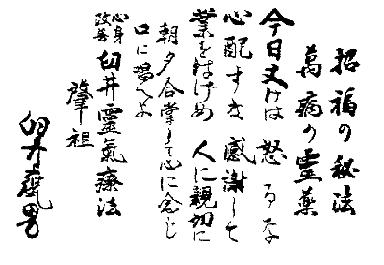
Reiki Precepts
Reiki is not just about connecting to energy and healing yourself or others. Reiki students traditionally were provided with a series of precepts to follow.
Precepts meaning a moral instruction, a rule of conduct or a guidance on how to live a spiritual life. They are an important aspect to practising Reiki, and are a set of ideals to work towards, that you should try to follow as much as you can each day, alongside daily energy exercises and meditation.
This is translated as:
The secret of inviting happiness through many blessings. The spiritual medicine for all illness.
For today only:
-
Release anger
-
Release worry
-
Be humble
-
Be honest in your work
-
Be compassionate to yourself and others
Do gassho every morning and evening. Keep precepts in your mind and recite.